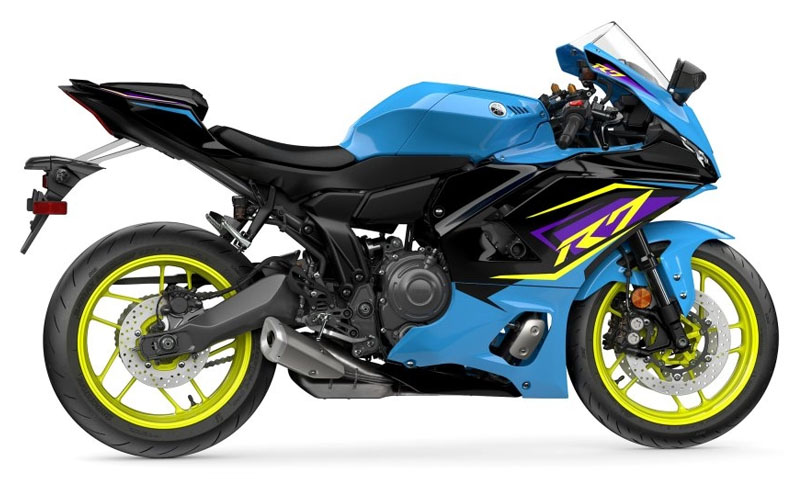
Yamaha YZF-R7 2026 року — Specs & Overview
Yamaha YZF-R7 — Complete Buyer's Guide (2022–2026)
The Yamaha YZF-R7 is a middleweight supersport motorcycle powered by a 689cc liquid-cooled parallel-twin engine (Yamaha's CP2 platform) producing approximately 74 horsepower. Launched in 2022 as a road-going middleweight, the 2026 YZF-R7 introduces a chassis redesign, updated suspension, ride modes, and a revised MSRP of $9,399. The R7 sits between Yamaha's track-only R6 and the R3 in the supersport lineup, designed for riders who want sportbike styling with street-friendly power delivery.
Key features
Technical specifications
Engine
Transmission
Chassis
Electronics
Other
Yamaha R7 history: how it changed from 2022 to 2026
The Yamaha YZF-R7 has existed in two distinct generations since its modern revival:
1999 YZF-R7 (OW-02)
Original race-replica limited to 500 units worldwide, qualifying-only superbike for the former World Superbike homologation rules.
Gen 1 (2022–2025)
Road-going middleweight supersport with the CP2 parallel-twin engine. Initial launch as a 2022 model, with year-over-year changes limited primarily to color and graphics updates.
Gen 2 (2026)
Significant redesign including new chassis, revised suspension, different riding position, ride modes (Sport, Street, Rain, Custom, plus four track modes), and updated electronics. MSRP increased by $200 from the previous model year.
For year-specific details, see:
Yamaha R7 specs: 2022 to 2026 comparison
| Spec | 2022–2025 (Gen 1) | 2026 (Gen 2) |
|---|---|---|
| Engine | 689cc CP2 parallel-twin | 689cc CP2 parallel-twin |
| Power (hp) | ~72 hp | ~74 hp |
| Torque | ~50 lb-ft | ~50 lb-ft |
| Transmission | 6-speed | 6-speed |
| Chassis | Gen 1 frame | New Gen 2 frame |
| Suspension | Standard KYB | Revised KYB (Gen 2) |
| Riding modes | None | Sport / Street / Rain / Custom + 4 track modes |
| Quick shifter | Optional | Standard |
| MSRP (new) | $8,799–$9,199 (verify per year) | $9,399 |
Confirmed: 2026 MSRP. Other rows are general industry figures for the R7 platform; verify each cell from Yamaha's official spec sheets for each model year.
Yamaha R7 top speed, 0-60, and quarter mile
Stock top speed: approximately 140–145 mph (verified per CycleWorld, MotorcyclistOnline, and Rider magazine tests).
0-60 mph: approximately 3.0–3.5 seconds.
Quarter mile: approximately 10.5–11.0 seconds.
Performance figures vary by rider weight, conditions, and test methods. Yamaha does not publish official performance numbers. Verify against current published instrumented tests.
Top speed without limiter
The R7 has an electronic top-speed limiter. Removing or remapping the limiter (closed-course use only) can yield higher top speeds, with owner reports in the 150+ mph range.
Yamaha R7 price by year
| Year | MSRP (new, USD) | Typical used market value |
|---|---|---|
| 2026 | $9,399 | Not yet available |
| 2025 | $9,199 | $8,500–$9,500 |
| 2024 | $9,099 | $7,800–$8,500 |
| 2023 | $8,999 | $7,500–$8,200 |
| 2022 | $8,799 | $6,999–$7,800 |
2026 MSRP confirmed from Yamaha. Earlier years' MSRP and used values are general market estimates; verify with current marketplace listings before publishing.
Yamaha R7 vs R6 vs MT-07
The R7 is the middle child in Yamaha's sport-focused middleweight range. Riders comparing these three bikes usually face this exact decision.
| Spec | Yamaha R7 (2026) | Yamaha R6 (2020 / Race) | Yamaha MT-07 (2026) |
|---|---|---|---|
| Engine | 689cc parallel-twin | 599cc inline-4 | 689cc parallel-twin |
| Power | ~74 hp | ~117 hp | ~74 hp |
| Category | Middleweight supersport (street) | Supersport (track only, post-2020) | Hyper-naked |
| Ergonomics | Sport-touring | Aggressive track | Upright naked |
| Best for | Everyday sportbike, canyon carving, sport touring | Track days, racing, performance | Commuting, urban, learning |
| MSRP | $9,399 | R6 not sold street-legal in US since 2020 | $8,599 |
Which should you buy?
- R7 if you want a real sportbike you can ride every day, with full fairing and sport ergonomics.
- R6 if you have a track day or racing license and want pure supersport performance. Note: the R6 has not been sold as a street-legal bike in the US since 2020 — you cannot buy a new 2026 R6 for the road.
- MT-07 if you want the same engine in a more upright, beginner-friendly package at a lower price.
Common Yamaha R7 problems
Before buying any model year, check these common R7 ownership issues reported by long-term testers and owners:
- Quickshifter on early Gen 1: some 2022–2023 owners report occasional quickshifter hesitation at lower RPMs under hard acceleration. Yamaha released ECU updates — verify the unit you're considering has the latest firmware.
- Aftermarket exhaust tuning: stock map assumes stock exhaust. Aftermarket slip-ons without a re-map can cause running lean, especially at low throttle.
- Suspension settling: Gen 1 (2022–2025) suspension is well-regarded for the price but benefits from a suspension setup for riders over 175 lb. Gen 2 (2026) revised suspension is reportedly better for heavier riders from the factory.
- Tire wear: the R7's sport geometry and OEM tire compound lead to faster rear-tire wear than competitors like the Ninja 650. Plan on shorter tire replacement intervals.